

Grand Theft Auto VI arrives with the sort of reputation that can crush lesser games before launch, but Rockstar has never been in the business of making lesser games. After years of rumors, leaks, and speculation, the real surprise is not that GTA 6 exists, but that it feels so confident in what it wants to be. This is not a simple sequel that repeats the old formula with prettier lighting; it is a full reset of the open-world crime sandbox, built for a generation that expects worlds to breathe, systems to collide, and every street corner to hide a story.
As someone who has spent far too many nights testing every crack in the Grand Theft Auto formula since the PS2 era, I can say this with confidence: GTA VI is the first entry that makes the world itself feel like the main character. The crime, the satire, the chaos, the side activities, and the social systems all orbit around a map that feels alive in a way few games can match. It is not just a place to drive through while waiting for the next mission. It is a place that watches you back.
A world that finally feels awake
The headline feature here is obvious: the map. The return to Vice City-style energy gives GTA VI a sunburned, neon-soaked identity that feels sharply different from the colder tone of its predecessor. The streets have density, the beach areas have a constant flow of noise and movement, and the rural edges of the map are just as carefully built as the urban core. This is the rare open world where entering a diner, parking garage, marina, or off-road backroad can all produce a different mood.
Rockstar has always been good at environmental detail, but GTA VI pushes it into something closer to social simulation. Pedestrians react more naturally, traffic patterns feel less canned, and random events are woven into the city with less of that “game system” stiffness that sometimes breaks immersion. Even after long sessions, I kept noticing tiny touches: conversations that shift depending on time of day, police presence that changes the rhythm of a district, and weather that affects how the whole place feels rather than simply how it looks.
If you are the type who likes to play open-world games by ignoring the main story for hours, this is close to paradise. The game gives you a city that rewards wandering without making that wandering feel like filler.
Two leads, one sharp edge
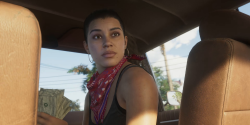
Lucia and her partner give GTA VI a different emotional center than earlier entries. The series has often used criminal ambition as a joke, a tragedy, or a parody, but this pair makes the story feel more personal without losing the franchise’s trademark bite. Their dynamic is not just about crime; it is about trust, pressure, survival, and what happens when two people try to climb out of bad circumstances using the worst possible tools.
What impressed me most is that the writing doesn’t drown in self-seriousness. Rockstar still understands that this series lives on contrast. One minute you’re watching a tense exchange that actually matters, and the next you’re in the middle of some absurd side incident that reminds you this is still Grand Theft Auto. That balance is tricky, but GTA VI handles it better than expected. The main campaign has weight, yet it never forgets the series’ black comedy roots.
There are moments where the story threatens to over-explain itself, but it usually recovers by putting the player back into motion. That’s the secret strength of the game: it knows how to get out of its own way.
Gunfights, driving, and the feel of control
Moment to moment, GTA VI is cleaner and more deliberate than GTA V. Shooting has better feedback, cover transitions are less clumsy, and forced positioning during combat is less likely to punish you for simple camera issues. The action is still unmistakably Grand Theft Auto, meaning it is rarely a precision shooter, but the gunplay has enough weight and responsiveness to hold up in longer sessions without feeling dated.
The driving remains one of the series’ greatest pleasures. Cars have noticeable differences in mass, grip, and braking, and that matters because the map is designed to make every route feel like a decision. High-speed chases are more suspenseful when you can actually feel the vehicle sliding across a wet road or fighting for traction on rougher terrain. Boats, bikes, and off-road vehicles also have more reason to exist, which is a good sign for mission variety and general free-roam enjoyment.
What stands out is how often the game lets systems overlap. A chase may turn into a traffic pileup, which then becomes a shootout, which then becomes a desperate escape across rooftops or water. That chain reaction is the soul of GTA, and VI understands it better than most games in the genre.
Systems with room to breathe
One of the smartest decisions here is the refusal to overload the player immediately. Yes, there are plenty of activities, side jobs, and distractions, but they are introduced with a better sense of pacing than before. The game seems to trust that you will explore, and because of that, exploration feels earned rather than forced.
There is also a more believable economy to everyday life in the world. Stores, nightlife, side businesses, property-like systems, and character interactions all contribute to a wider sense that the city is more than a backdrop. This is the kind of game where you can log in expecting a quick mission and end up spending an hour managing your route, your cash flow, and your next move. That may sound like busywork on paper, but in practice it deepens the fantasy of being part of a living criminal ecosystem.
For players who care about replay value, this matters a lot. A giant map is nice, but a giant map with layered systems is what keeps people coming back after the credits roll.
Technical polish, with the usual Rockstar scale issues
Let’s be honest: no Rockstar launch is ever “small.” Even with a polished release, there are always moments where the ambition shows its seams. In a game this large, edge cases are unavoidable. NPC routines can occasionally clash with mission scripting, long drives can expose repetition in traffic behavior, and some sequences may feel more cinematic than interactive. None of that is shocking. The key question is whether the game holds together under pressure, and for the most part, it does.
On strong hardware, GTA VI looks absurdly good. Lighting, character animation, reflections, and environmental detail all work together to create one of the most convincing open worlds ever assembled. The presentation is so confident that even routine errands can feel cinematic. It is the sort of game that makes screenshots look planned even when they were accidental.
Audio deserves special mention. The radio selection, ambient street noise, distant sirens, and voice performances all do a huge amount of work. You can hear the city before you see it, and that is exactly what a great open-world game should do.
What it means for long-time fans
If you came here hoping for “GTA V but bigger,” you will get more than that. If you came hoping Rockstar would finally modernize the series’ systems without losing its identity, you will likely be satisfied. GTA VI is still recognizably Grand Theft Auto, but it feels less like a greatest-hits compilation and more like a decisive step forward.
The biggest compliment I can give it is simple: it made me want to keep playing in a way that respected my time. I wanted to finish missions, yes, but I also wanted to see what happened if I detoured, experimented, or simply drove until something interesting happened. That instinct is what separates a good open world from a memorable one.
It also helps that the game leaves room for community creativity. Once the inevitable mods arrive on supported PC versions, the lifespan of GTA VI will expand dramatically, just as fans expect from this series. There will also be endless discussion around cheats, emergent exploits, and ways people bend the rules to make chaos even stranger. That has always been part of the GTA culture, and this game is built to feed it.
Final verdict
Grand Theft Auto VI is not perfect, but it is absolutely the kind of game people will spend years talking about. It combines a stronger emotional core with a richer open world, cleaner action, and a more believable city than any previous entry. For veteran players, it feels like Rockstar finally pushing the series into a modern shape without losing the danger and humor that made it famous.
If your idea of a great game is one that lets you explore, improvise, break routine, and get lost in a world that seems to keep moving after you leave it, GTA VI is built for you. It is bold, expensive-looking, endlessly reactive, and already feels destined to define discussion around open-world design for the next several years.
How to download Grand Theft Auto VI
Availability & Launch: Grand Theft Auto VI is a premium release, so it is not free in normal storefronts. You can download it through official digital stores at launch, or buy a physical copy where available. Access depends on the release window in your region.
Platforms: GTA VI is confirmed for current console platforms first, with PC support expected later depending on the official rollout. If you want to play on unsupported devices like older consoles, Android, or Mac, you should not expect native support; cloud streaming or remote play may be the only practical options, and emulator use is not recommended for a modern game of this scope.
Install: To install, purchase the game from the official store, download the installer or game files, sign in to the required platform account, and follow the prompts. On consoles, the game installs automatically after purchase and download.
System Requirements: For PC, expect a modern multi-core CPU, a recent GPU with ample VRAM, 16 GB RAM or more, and plenty of SSD space. Exact minimum specs for Mac and Android are unlikely to apply unless cloud play becomes available.
Cheats / Mods: Cheats may appear in single-player, but online use is usually restricted. Mods are typically a PC-only community feature and are not guaranteed at launch.
Unblocked Access: This is not a game designed for unblocked access at school or work. Network filters, platform restrictions, and account sign-ins will usually prevent easy play in locked-down environments.